
How We Got to Heads-Up
The 2003 WSOP Main Event had 839 players. I came in as one of the chip leaders at the final table — which sounds better than it was, because I’d spent the previous days doing things I didn’t fully understand were correct. I abused the bubble. I bluffed Scotty Nguyen. I busted Johnny Chan, one of the three players I actually knew by name going in. I ran good when I needed to run good.
By the time we got heads-up, I had roughly a 2-to-1 chip lead on Sammy. That helped. But Sammy Farha was a seasoned professional who knew exactly what he was doing. His strategy was straightforward: use experience to outmaneuver me, avoid big pots, grind. He figured time was on his side.
My read on him was different. I thought he wanted to keep pots small. So I decided to play big pots. That’s a simplified version of the logic, but that was the general direction.
The Hand — What Actually Happened
I was dealt 5♦ 4♠. Not a strong hand. In most situations, not a hand you build a $2.5 million moment around.
The flop came J♥ 5♣ 4♦.
I’d flopped two pair. Bottom two pair, but two pair. The thing is — I’d played the hand before the flop like I had nothing, and now I was sitting on a disguised monster with position. Sammy, based on how I read him, likely had a piece of that jack.
What I did next: I moved all-in.
From the outside, it looks like a bluff. That’s how ESPN framed it. That’s how most people remember it. And technically, when I moved in, I was representing a hand I didn’t have — the board favored a jack, not a 5-4. But the actual cards I held were two pair. So it was a bluff that happened to be backed by a real hand. A confident move dressed up as something it wasn’t.
Sammy tanked. He had J♠ — top pair. He stared at the board. He stared at me. He folded, face-up, and said something like: “I think you have a good hand.” He wasn’t wrong. He also wasn’t wrong to fold — in today’s game, most players would probably call there. In 2003, the ranges were narrower and all-in bets carried more weight.
We replayed that heads-up matchup years later, three times, with the same starting stacks. I won when I had my original chip counts. He won when he had mine. When we started even, I won that one too. I don’t mention that to make a point. It’s just what happened.
What Sammy Saw That I Didn’t
Here’s the thing about that hand that gets lost: I wasn’t trying to be brilliant. I was applying pressure because I thought he didn’t want to play a big pot, and I had just enough of a hand to feel comfortable going all the way with it. It wasn’t a masterclass. It was a read combined with a situation that happened to work out.
Sammy later said he thought I had a strong hand. He was right. What he couldn’t have known — and what most viewers couldn’t have known watching the ESPN replay — is that “strong hand” in this case was bottom two pair with a board that looked like it favored him. He folded the better hand. That’s the part that’s genuinely unusual.
In today’s game, with solvers telling everyone the theoretically correct play in every spot, that fold gets called almost automatically. The math says call. But 2003 wasn’t being solved by software. It was being solved by feel, and Sammy’s feel told him to get out. You can’t really criticize that too hard. His feel was right about a lot of things that week — just not that specific fold.
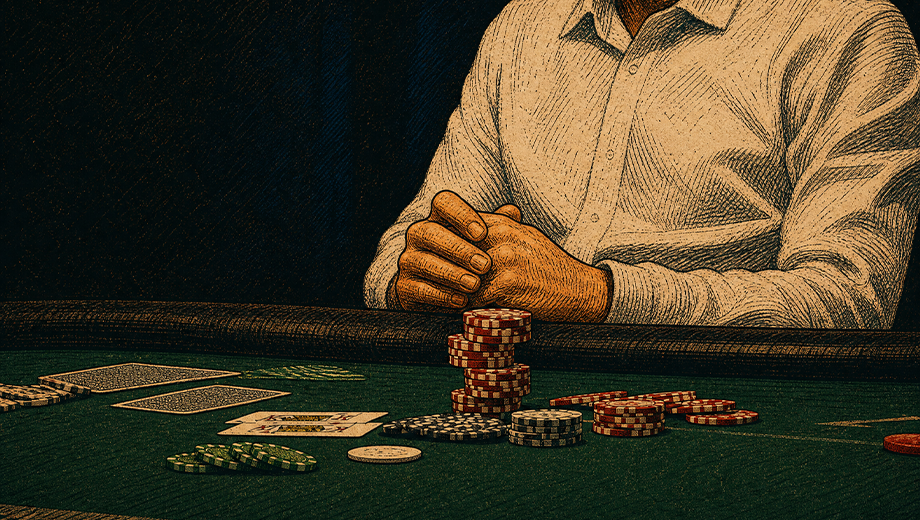
The Read That Made It Possible
What I’d been doing throughout the tournament — and specifically at the final table — was watching. When I folded a hand, I paid attention to what everyone else did with theirs. I tried to guess cards. I checked whether I was right at showdown. Repeat for six days. By the time we got to heads-up, I had a decent model of how Sammy played.
My read was that he wanted control. Small pots. Positional edges. Patient play. So the counter was to remove control from the equation — make the pot big enough that patience became irrelevant.
That’s not a complicated strategy. It’s observation applied to execution. The hand on J♥ 5♣ 4♦ was the clearest version of that playing out.
What the Numbers Looked Like That Year — And After
The 2003 field was 839 players. That seems small now. Here’s what happened to the Main Event in the years that followed.
| Year | Main Event Entries | First Place Prize |
|---|---|---|
| 2001 | 613 | $1,500,000 |
| 2002 | 631 | $2,000,000 |
| 2003 | 839 | $2,500,000 |
| 2004 | 2,576 | $5,000,000 |
| 2005 | 5,619 | $7,500,000 |
| 2006 | 8,773 | $12,000,000 |
From 839 to 8,773 in three years. I almost never think about that. Only when I’m at the WSOP and it’s right in your face.

Going Back to Work Monday Morning
I won on a Friday. Flew home Saturday. Party Saturday, day off Sunday. Monday morning I was back at my desk. The ESPN broadcast didn’t air until August — three or four months after the actual win. So I returned to a world where roughly 30 people knew what had happened. No social media. Flip phones. The internet was reporting it, but it wasn’t everywhere yet.
That’s the part of this story that still feels strange to me. The hand against Sammy — the bluff, the fold, the chips sliding across the table — happened in a room in downtown Las Vegas in front of a few hundred people. By August it was on television in front of millions. By 2004 the Main Event field had tripled. But on the Monday after it happened, I was just a guy who’d had a very good week and needed to get back to the office.
The Moneymaker Tour runs the same basic format I qualified through — low buy-ins, real structure, real prize pools. If you want to see what that looks like today, the schedule is live on this site.
Frequently Asked Questions
What hand did Chris Moneymaker have in the final hand against Sammy Farha?
Moneymaker held 5♦ 4♠. The board was J♥ 5♣ 4♦, giving him bottom two pair. He moved all-in representing a stronger holding, and Farha folded top pair (J♠) face-up. The hand was broadcast on ESPN and became one of the most replayed moments in poker television history.
Was the famous Moneymaker bluff actually a bluff?
Not exactly. Moneymaker held bottom two pair on the J♥ 5♣ 4♦ board — a real hand, though a disguised one. He played it aggressively to represent a stronger holding and moved all-in. Farha, holding top pair with J♠, folded. It’s more accurately described as a value-bluff hybrid than a pure bluff.
How many players were in the 2003 WSOP Main Event?
839 players entered the 2003 WSOP Main Event at Binion’s Horseshoe in Las Vegas. The total prize pool was $7,987,860. Moneymaker won first place for $2,500,000. Sammy Farha finished second and received $1,300,000.
How did Chris Moneymaker qualify for the 2003 WSOP Main Event?
Moneymaker entered an $86 satellite on PokerStars — accidentally, thinking it was a cash sit-and-go. He won that satellite into a $615 qualifier with 69 players that awarded 3 Main Event seats. He won a seat, couldn’t sell it (seats were non-transferable that year), and played the Main Event for the first time.
Did Sammy Farha make a mistake folding in the final hand?
By modern standards, folding top pair to an all-in in heads-up play is generally considered incorrect. In 2003, all-in bets carried more weight and ranges were interpreted more narrowly. Farha’s read — that Moneymaker had a strong hand — was actually correct. He folded to two pair. Whether the fold was wrong depends on the framework you apply.
What happened to the WSOP Main Event after Moneymaker won in 2003?
The field grew dramatically. In 2004 it went from 839 to 2,576 players. By 2006 it reached 8,773 — more than ten times the 2003 field. The prize pool grew proportionally. This growth, driven in part by the ESPN broadcast of Moneymaker’s win and the resulting online poker boom, is often called the Moneymaker Effect.