
By hour fourteen, you stop feeling your feet. Not because anything is wrong — just because you’ve been sitting in the same chair since noon and the body eventually stops sending updates on the parts that aren’t doing anything useful. The brain is still running. The brain is always running. But everything below the waist has basically clocked out and gone home.
That’s what a full WSOP day actually feels like. Not the ESPN version. Not the highlight reel with the music and the chip counts on screen. The real one — the one that ends somewhere around 2am with 400 fewer players in the field and a bag of chips you have to count before you leave the floor.
The First Four Hours Feel Like Nothing
Day 1 of the Main Event is almost boring. I’ve said this before and I’ll say it again: Day 1 is a job. You show up, you play your cards, you try not to do anything stupid. The field is too big, the structure is too deep, and most of the people at your table are just trying to survive. Nobody is taking shots. Nobody is building a stack. Everyone is being careful.
That’s actually the most dangerous time to play. Careful poker is predictable poker. And predictable poker is the kind that gets you in trouble when someone finally decides to make a move.
The first four hours, I’m on autopilot. Observe. Fold. Observe. Pick a spot. Move on. The reads I build in those four hours are what I actually use later — when the structure gets shorter, the blinds get bigger, and everything speeds up.
Hours Five Through Eight — This Is Where It Gets Real
Somewhere around level five or six, the table changes. Players who came in cautious start getting either comfortable or desperate — and both of those things create opportunities. Comfortable players start splashing around. Desperate players start shoving. Either way, the information flow gets richer.
This is also when the physical thing starts. Not pain — just weight. You become aware of how long you’ve been sitting. The coffee from two levels ago is gone. The food break felt like it ended ten minutes ago even though it was three hours back. Time compresses in a way that’s hard to explain until you’ve lived it.
What I do during this stretch: when I fold a hand, I watch. I try to put everyone on a range before the hand plays out. I check myself at showdown. Right or wrong, I learn something. Repeat for three more levels. By hour eight I have a working model of every player at my table — how they play scared money, how they play big stacks, what they do when they’re out of position.
It’s not rocket science. It’s simple observation.
The Part Nobody Talks About — Hours Nine Through Eleven
This is the wall. Everyone hits it at a different time, but it’s there. Hour ten, roughly. The hands start blurring together. You can’t quite remember if you folded Ace-King in level four or level seven. The chip counts across the table feel approximate rather than precise. Your brain wants to simplify — play fewer hands, make easier decisions, get to the bag.
The players who are still dangerous at this point are the ones who fight the simplification. Who stay specific. Who remember that the guy in seat three checked back the flop three times today when he had a medium pair. Those details don’t disappear — but you have to actively hold onto them when your brain is trying to run on fumes.
What I do: between hands, I close my eyes. Not sleeping — meditating. Or something that looks like meditating from across the table. Whatever you want to call it. The point is to stop processing for thirty seconds and come back sharp. It works about half the time. The other half I’m just sitting there with my eyes closed.
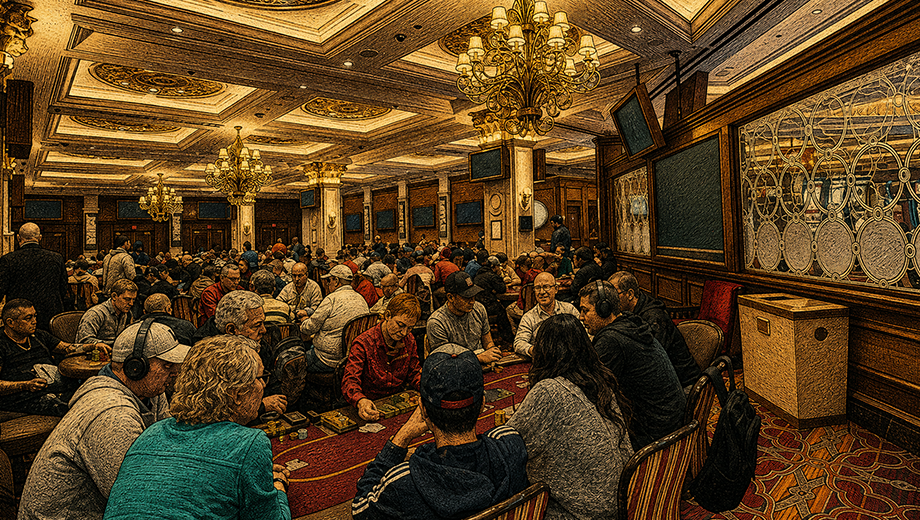
What Hour Fourteen Actually Does to Your Reads
Here’s the thing that surprises people: the reads don’t get worse at hour fourteen. They get different.
Early in the day, reading someone is an active process. You’re collecting data, building a profile, testing it. By hour fourteen, it’s more like intuition — except it’s not actually intuition. It’s the compressed output of thirteen hours of watching the same people. When seat six bets big on the river, you know without thinking whether that’s strength or desperation. You’ve seen the pattern fourteen times already.
The danger is trusting that feeling too much. Late in a long day, you start to feel like you know things you don’t actually know. You’ve built confidence on pattern recognition, which is real — but it can also calcify into assumptions. The guy who played tight all day might be exhausted and loose now. The read you built in level three might not apply in level twelve.
Staying honest about that is the actual discipline. Not the cards. Not the math. The willingness to update your read when the evidence says to.

How the Day Ends
The floor staff announces the last hand of the night. Everyone at the table knows it’s coming. Some players tighten up — don’t want to lose chips on the last hand of Day 1. Some players loosen up — figure it’s their last shot to accumulate before the bag.
I’ve never really gotten nervous at this point. We’re playing cards. The nervousness, if it was ever going to show up, had its chance six hours ago. By the last hand of the night, it’s just arithmetic. Count your chips. Fill the bag. Write the number on the outside. Hand it to the floor. Go find something to eat.
The walk out of the Rio — or wherever the Main Event is that year — at 2am is its own kind of strange. Thousands of people in that room ten hours ago. Half of them gone. The ones still here walk out quieter than they walked in. Not sad. Not relieved. Just done for the day.
Day 2 starts at noon. The alarm goes off at nine. That’s the math of a WSOP Main Event day, and it doesn’t change regardless of how your bag looks.
If you’re thinking about playing the Main Event for the first time, the Moneymaker Tour runs the same multi-day format on a smaller scale — same structure, same endurance, same rhythm. Worth knowing what a long day feels like before you get to Vegas.
Frequently Asked Questions
How long is a typical WSOP Main Event day?
A standard WSOP Main Event day runs approximately 10 to 14 hours, depending on the level structure and how quickly the field thins. Players typically start around noon and finish between midnight and 2am. Each two-hour level includes a short break, with one longer dinner break mid-session.
How does Chris Moneymaker stay focused during long WSOP sessions?
Moneymaker uses the time between hands to observe opponents and build reads — even when he’s folded out of a hand. During long sessions he closes his eyes between hands to reset mentally, which he describes as a way to stop processing noise and come back sharp. He has also described using his iPad or watching movies during breaks to rest his mind.
Does Chris Moneymaker get nervous playing the WSOP?
He says no. In his own words: “I’ve never really gotten nervous playing poker. We’re playing cards. Have fun.” He has described wrestling and boxing as the activities that produce real nerves — contact sports where physical consequence is immediate. Poker, however long the day, doesn’t trigger the same response for him.
What does Moneymaker think about Day 1 of the WSOP Main Event?
He finds it boring. Day 1 is a survival exercise — deep structures mean nothing is forced, and most players are cautious. He uses Day 1 primarily to observe opponents and build reads he’ll rely on in later levels. Day 2 onward is where he gets activated: accumulating chips, setting traps, reading who’s in survival mode.
How has Chris Moneymaker qualified for the WSOP Main Event?
In 2003, Moneymaker entered an $86 online satellite on PokerStars — accidentally — and won his way through to the Main Event. He has played the Main Event every year since 2003. His 2003 win, coming from an $86 satellite entry, directly inspired the format used by the Moneymaker Tour today.
What is the biggest mental challenge in a long WSOP day?
Staying specific. After ten or more hours, the brain wants to simplify — play fewer hands, rely on feel rather than observation, make shortcuts. The players who stay dangerous late in a session are the ones who resist that pull and keep updating their reads as the table dynamics shift throughout the day.