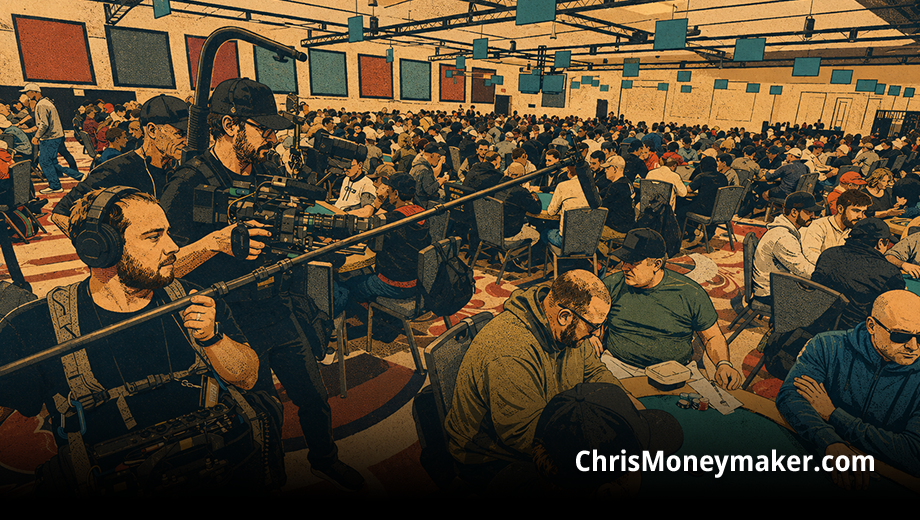

Day 1 of the World Series of Poker Main Event is one of the best days of the year.
There’s really nothing else like it.
You walk into the room, thousands of players are sitting down, and everybody still has a chance. Nobody has won anything yet. Nobody knows who’s going to make a deep run. You’ve got amateurs sitting next to pros, qualifiers sitting next to bracelet winners, and somewhere in that room is probably a guy who’s going to have his life completely changed.
I know a little something about that.
This year, my Day 1 started with pickleball, a random seating coincidence that I still can’t explain, a pretty comfortable climb from 60,000 to more than 90,000 chips, and then four straight hours where I basically forgot what it felt like to win a poker hand.
By the end of the night, I was exhausted, frustrated, watching a show on my iPad at the poker table, and doing everything I could to make sure I didn’t turn a bad stretch of cards into a busted Main Event.
It wasn’t pretty.
But I survived.
And in this tournament, that’s what matters.
Pickleball Before Poker’s Biggest Tournament
My Main Event day didn’t exactly start with meditation and hand charts.
I was out playing pickleball.
ESPN was filming a segment called The Nuts, and we had the Grinder out there, Renee from Storage Wars, my boy Bruce, and a few others. Somehow, I’ve found another sport besides poker where I can get competitive.
I never really expected that.
The funny thing was that the Main Event was starting in about five minutes, and I was still out there messing around. The plan was simple: finish up, get back, shower, and get ready to play.
I felt good.
That matters more than people realize in the WSOP Main Event. This tournament is such a grind that your mental and physical state can be just as important as the cards. You know you’re going to be sitting there for hours. You know there will be long stretches where nothing happens. You know the tournament can wear you down.
At that point, though, I was fresh and ready to go.
Then I found out who was sitting next to me.
One of the Craziest Seating Draws I’ve Ever Seen
When I got to the table, I realized I was sitting directly to the left of Brandon, who had won his seat through our club in Louisville.
Think about that.
There were thousands of people playing that day, and somehow the guy we sent from our club to Las Vegas ended up sitting immediately to my right in the World Series of Poker Main Event.
You couldn’t script it.
People joke about poker being rigged all the time. I can rig some stuff, but I definitely can’t rig that one.
It was great having him there. The Main Event is already a special experience, but getting to share the table with somebody connected to home made it even more fun.
Unfortunately, the poker itself didn’t start out all that exciting.
I barely won a pot in Level 1.
I also didn’t lose much.
I finished the first level with around 56,000 from the 60,000 starting stack, which was completely fine. My big goal at that point was simple: make it 30 minutes into Level 2.
That would already be better than last year.
Sometimes you’ve got to set realistic goals.
One Level at a Time
The biggest mistake people make in the Main Event is thinking too far ahead.
You can’t win this tournament on Day 1.
You can definitely lose it on Day 1.
That’s the difference.
My approach early was to take it one level at a time. Survive the next level. Get to the next break. Don’t do anything stupid. Let the tournament come to me.
The early stages are the easy part.
The real fun, if you’re lucky, starts about five days later.
My table was pretty soft, but it also wasn’t the kind of table where I expected to build a gigantic stack. Nobody was getting completely out of line. There weren’t many bloated pots. There wasn’t a ton of variance.
Honestly, if I finished the day with around 90,000, I figured that would be a win.
Of course, table dynamics can change quickly. You move to a feature table, everything changes. One aggressive player sits down, everything changes. Somebody decides they’re going to play every pot, everything changes.
But for most of the early part of the day, I was perfectly happy just grinding.
The Quiet Climb to 93,000
By dinner break, I had worked my stack up to 93,000.
Nothing spectacular had happened.
I hadn’t played any massive pots. I hadn’t been put in any brutal spots. I hadn’t needed to make some heroic call or incredible laydown.
It was just a steady grind.
I did go for some thin value with two pair on a straight board after the river paired, but even that wasn’t some huge defining hand. Mostly, I was making small decisions, picking up chips, and avoiding disasters.
That’s exactly how I like Day 1 of the Main Event to go.
I started with 60,000 and had 93,000 at dinner.
Not bad.
I even started thinking that maybe I could finish the night with 200,000.
That thought didn’t age particularly well.
When the Wheels Fell Off
I came back from dinner and basically stopped winning poker hands.
Completely.
I went from 93,000 to around 40,000.
For about two hours, I lost everything I played. Then it kept going. I missed flops. My bluffs didn’t work. I couldn’t make a hand.
It was just one of those stretches.
The biggest pot came when I had ace-queen in the cutoff against a player on the button who had been three-betting me a lot.
I four-bet to 16,000.
I don’t love four-betting in the Main Event, especially on Day 1. Ace-queen is probably about the bottom of my range there, but given how often he had been three-betting me, I decided to go with it.
He called.
That was not what I wanted.
The flop came king-ten-eight, all clubs.
I had ace-queen with two red cards.
Terrible flop.
Terrible situation.
I looked at him, looked at the board, and felt like he didn’t have much. I didn’t think he had ace-king. He could obviously have some clubs, but I wasn’t convinced he had enough of them.
So I bet 12,000.
He thought for a while and called.
Now I had a problem.
The turn was a seven. I considered firing again, but I checked. He looked like he was thinking about betting, then eventually checked behind.
The river went check-check pretty quickly.
He turned over ace-queen too.
The difference was that he had the queen of clubs.
We chopped the pot.
So after all that, nobody won.
That was pretty much the theme of my night.
Knowing When to Stop Fighting
The most important decision I made all day had nothing to do with a specific poker hand.
I turned on my iPad.
I was down to around 40,000. I was tired. I had been losing for hours. I wasn’t feeling sharp, and I could feel the frustration building.
That is exactly when you can do something stupid.
The blinds were still small. I had plenty of chips. I was in absolutely no danger. But when you’ve been missing everything for hours, it’s easy to convince yourself that you need to force something.
You start trying to turn ace-king into a bluff.
You start taking a spot that isn’t there.
You start telling yourself that you need to win your chips back before the end of the day.
You don’t.
I knew if I kept trying to make things happen, there was a very good chance I’d bust.
So I watched my show.
I hung out.
I thought about getting a massage.
I waited for good hands.
I basically decided that my only job was to get through the day.
People might think watching something at the table means you’re not focused. In that moment, it was the opposite. It was how I protected myself from making a bad decision.
If I hadn’t turned on that iPad, I honestly think I might have been out.
Four Hours Without Winning a Hand
When I say I didn’t win another hand after dinner, I mean I basically didn’t win another hand.
For hours.
I had no hands. I made nothing. I missed every flop. Every bluff failed.
But here’s what makes the World Series of Poker Main Event different from almost every other tournament.
You can run terribly for four hours and still be okay.
In most tournaments, if you go four or four and a half hours without making a hand, you’re done. Your stack disappears. The blinds eat you alive. Eventually you’re forced into a spot and that’s it.
Not in the Main Event.
I had around 42,000 or 43,000 chips and was still perfectly fine.
That’s why this tournament is so special.
If you’re going to run bad, Day 1 is the place to do it.
I finally won a hand right near the end of the night when I made a straight with four-six.
That got me back to around 40,000.
Nothing glamorous.
No huge celebration.
Just enough to bag chips and come back.
The Main Event Is a Marathon
I finished Day 1 with a little over 50 big blinds.
After the way the second half of the day went, I was happy with that.
Of course, I would have preferred to bag the 90,000-plus I had at dinner. I would have loved to build a big stack and come back with 150,000 or 200,000.
But poker doesn’t care what you want.
There are days when the cards don’t come. There are days when every flop misses you. There are days when you’re tired and frustrated and just not feeling it.
I love poker.
I love the Main Event.
But that doesn’t mean every day is easy.
This one was hard.
The important thing is that I didn’t turn a hard day into my last day.
That’s the lesson of the Main Event. You cannot win this tournament on Day 1, but you can absolutely bust it. You have to treat it like a marathon, not a sprint.
Sometimes your best strategy is to build a big stack.
Sometimes it’s to attack a weak table.
And sometimes the best thing you can do is watch a show, fold some hands, and make sure you still have chips when they call it a night.
Sleep, Reset, and Come Back Ready
The next priority was getting some rest.
That gets more important the older I get.
I hadn’t been sleeping very well, and I knew that if I wanted to come back on Tuesday and play my best, I needed to fix that. I was even thinking about getting away from the Paris for a couple of nights.
I wanted some distance from poker.
If I stayed right there, I knew I’d be tempted to play cash or find another tournament or do something poker-related.
I didn’t need more poker.
I needed sleep.
Maybe a pool.
Definitely some ice cream.
The plan was to get away, reset, and come back ready to play.
Because despite everything that happened, I was still in the World Series of Poker Main Event.
I had chips.
I had more than 50 big blinds.
I had another day.
After four hours of running bad, that felt like a win.
The Main Event is going to test you. It’s going to frustrate you. It’s going to make you question decisions and wonder when the next good hand is coming.
The key is staying around long enough to find out.
Day 1 wasn’t pretty.
But I survived.
Now I get to come back and do it again.