
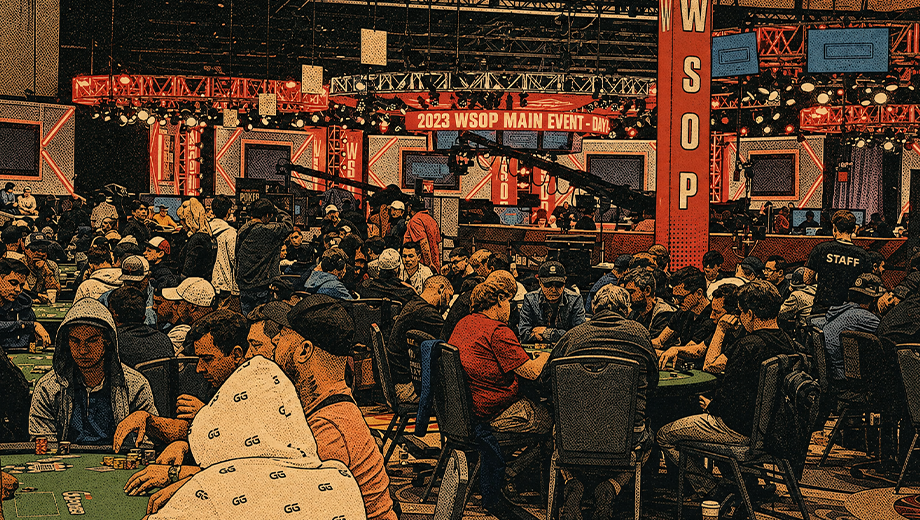
The tournament director says those four words and the room goes from loud to focused in about two seconds. Everyone sits down. Dealers start shuffling. And whatever you were thinking about — travel, sleep, the sandwich you ate an hour ago — it’s gone. You’re playing poker now.
I heard “Shuffle Up and Deal” for the first time at the 2003 WSOP Main Event. I was 27. I’d qualified online for $86. I had no business being there, and I knew it. What I didn’t expect was how quickly that feeling disappeared once the cards were in the air.
What That Moment Actually Feels Like
People ask about nerves. Here’s the honest answer: I’ve never really gotten nervous playing poker. I wrestled in high school. I boxed. Contact sports — that’s where you get nervous, because someone is physically trying to hurt you. Poker is cards and chips and strangers making decisions under pressure. The stakes are real, but nobody’s throwing a punch.
What I felt in 2003 wasn’t nerves. It was something closer to alertness. The room sharpens. You start paying attention to everything — who’s talking too much, who went quiet, who’s stacking their chips the same way every time. The pressure doesn’t paralyze you. It focuses you, if you let it.
The players who struggle in that moment are usually the ones who’ve built it up too much in their heads. They’ve been thinking about this for weeks. They’ve run scenarios. They’ve imagined the final table. And then they sit down and the first hand is just a fold, and the second hand is just a fold, and the whole thing feels anticlimactic until suddenly it isn’t.
Day 1 at the 2003 Main Event
I sat down with 10,000 chips and no real expectation of surviving the day. The field was 839 players — the biggest the Main Event had ever been, though nobody called it that at the time. It was just the number of people who showed up.
Dan Harrington was two seats to my right. I didn’t know that until I checked the wall of champions. I’d never heard of him. That’s not false modesty — I genuinely knew three player names going in: Phil Hellmuth, Doyle Brunson, and Johnny Chan. Harrington wasn’t one of them. Which meant I played him the same way I played everyone else at the table: watch first, figure out the pattern, then act.
The guy who gave me the most trouble early wasn’t a name anyone would recognize. He was wearing a PokerStars patch. His name was Jim Worth. He kept raising my big blind and I spent the better part of a level just trying to read him. The famous players weren’t the pressure point — the unknown ones were.
By the end of Day 1, I had 60,000 chips. Six times my starting stack. I went back to wherever I was staying, slept, and came back the next morning like I was going to work.
The Pressure That Actually Gets to People
It’s not the first hand. It’s not even the first day. The pressure that does real damage comes later — when the field has thinned and every decision has more weight behind it. On Day 1 you’re playing against 839 people and the math protects you a little. By Day 4 or 5, the math stops protecting anyone.
What I noticed in 2003 — and what I’ve noticed every year since — is that the players who fall apart aren’t the ones who got unlucky. They’re the ones who can’t recover from a bad beat. They take a hit, and instead of moving on, they carry it into the next hand. And the one after that. The tilt sets in quietly and then all at once.
Poker is about controlling your emotions and how those emotions affect your decisions. That’s the whole game, underneath all the strategy. The cards are almost secondary. What you do after a bad card — that’s what separates a deep run from an early exit.
I had a stretch on Day 2 in 2003 where I got a lot of money in with Ace-something against Kings on a ten-high board and lost. Walked outside. Felt like it was over. Came back in, sat down, and the very next hand I was dealt Aces. Almost doubled up immediately. If I’d been tilting, I might have played it wrong. I wasn’t. So I didn’t.
What “Shuffle Up and Deal” Means Now
I’ve heard those words at the Main Event every year since 2003. At some point they stopped being a signal to focus and became something more like a starting gun I’ve been hearing so long it’s just part of the rhythm. You sit down. The cards go out. You play.
What changes year to year isn’t the phrase or the format or even the pressure. It’s the field. The players who show up now have more volume behind them than anyone in 2003 could have imagined. An 18-year-old kid today can have more experience than Doyle Brunson got in his entire life — in six months. The game is harder. The starting gun is the same.
What hasn’t changed is the moment right before the first hand. The room goes quiet. Dealers shuffle. And for about three seconds, everyone at every table is equal — same chip count, same cards face down, same number of decisions ahead. That’s the only moment in the whole tournament where that’s true.
It doesn’t last. But it’s there.
If you’re planning to sit down at your first WSOP Schedule event this year, the feeling you’re building up in your head is bigger than what actually happens. Sit down. Watch the table. Fold a lot early. The pressure either sharpens you or it doesn’t — and you won’t know which until you’re in it.
The Part Nobody Prepares You For
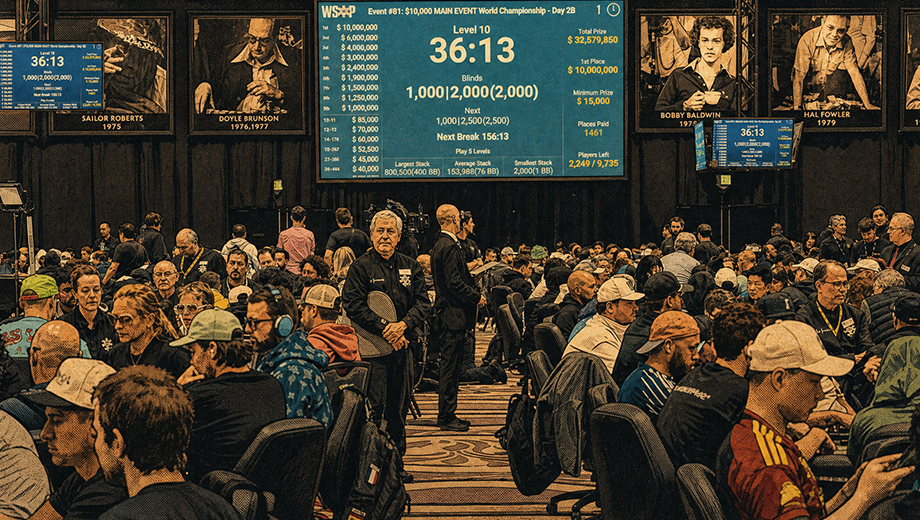
Day 1 bores me, honestly. Always has. You’re playing ten-handed, the stacks are deep, and most of the time you’re just waiting. Waiting for a hand, waiting for someone to make a mistake, waiting for the field to thin enough that the reads start to matter.
Day 2 is where I come alive. That’s when you can start to see who has chips and doesn’t want to risk them, who’s in survival mode, who’s ready to gamble. The fear becomes readable. And readable fear is a resource.
The pressure of “Shuffle Up and Deal” isn’t the four words. It’s everything that follows. The good news is that you don’t have to solve it all at once. You just have to play the next hand.
Frequently Asked Questions
What does “Shuffle Up and Deal” mean at the WSOP?
“Shuffle Up and Deal” is the traditional phrase used by the tournament director to officially start the World Series of Poker Main Event. It signals dealers to begin shuffling and marks the moment the tournament is underway. The phrase has been part of WSOP tradition for decades and is one of the most recognized moments in poker.
How did Chris Moneymaker handle the pressure at the 2003 WSOP Main Event?
Moneymaker has said he never really gets nervous playing poker — he credits his background in contact sports like wrestling and boxing for keeping the pressure of a card game in perspective. His approach in 2003 was observational: fold a lot early, watch the table, identify patterns, and act when the reads were clear. He ended Day 1 with 60,000 chips from a 10,000 starting stack.
What is the starting chip stack at the WSOP Main Event?
In the 2003 WSOP Main Event, every player started with 10,000 chips. Moneymaker bagged 60,000 by the end of Day 1 — six times the starting stack. Starting stacks at the Main Event have changed over the years; check the current WSOP structure sheets for up-to-date figures.
How many players were in the 2003 WSOP Main Event?
839 players entered the 2003 WSOP Main Event, the largest field the tournament had seen at that point. The prize pool totaled $7,987,860, with first place paying $2,500,000. Chris Moneymaker won the event after qualifying through an $86 online satellite.
What causes players to tilt at the WSOP Main Event?
Tilt at the WSOP typically comes from an inability to recover emotionally after a bad beat. Players carry the frustration of one hand into the next, letting emotion override decision-making. Moneymaker’s view: poker is fundamentally about controlling your emotions and how they affect your decisions — the strategy is secondary to that mental discipline.
Does Chris Moneymaker still play the WSOP Main Event?
Yes. Moneymaker has played the WSOP Main Event every year since his 2003 win. He has described it as the one tournament where the full history of his story is present — the ESPN footage, the questions about the famous bluff, the weight of what happened that year. It remains a fixture on his annual schedule.