
Las Vegas in June is not the city you see in the ads. It’s 110 degrees outside, the casinos are ice cold inside, and you’re going to spend twelve hours a day sitting in one chair making decisions with your brain while the rest of your body slowly stops working. The WSOP Main Event is a physical and mental endurance event dressed up as a card game.
I’ve made the trip every year since 2003. The packing list has changed a lot. In 2003 I showed up with a carry-on and no plan. These days I think more carefully about what I actually need to function for multiple days at peak capacity. Here’s what I’ve learned.
The Temperature Problem
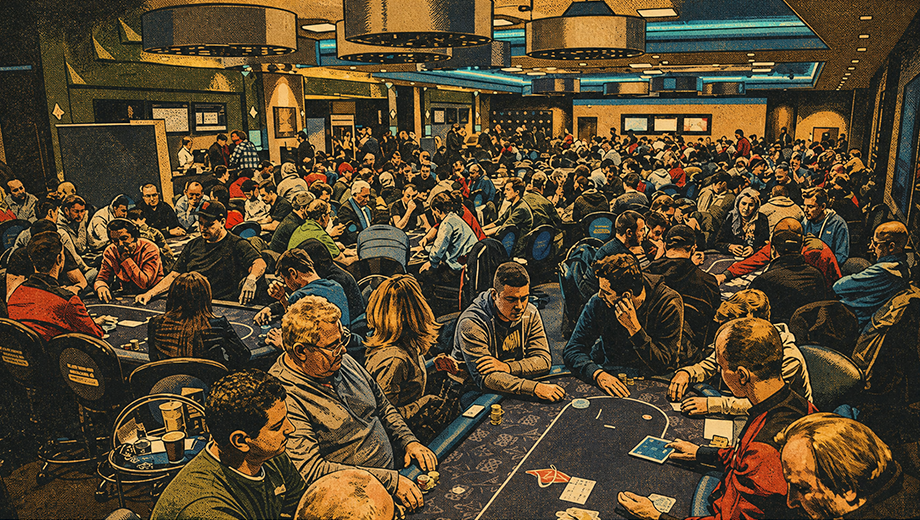
This is the one that catches first-timers every year without fail. Step outside — it’s June in the Nevada desert, somewhere around 105 to 115 degrees depending on the day. Step inside the casino — it feels like a refrigerator. The tournament floor is air conditioned aggressively, partly because of the equipment, partly because a room full of that many people generates serious heat.
The result is a constant oscillation between extremes. You’ll be sweating walking from the parking structure to the entrance. You’ll be reaching for a layer twenty minutes later at your table.
Pack layers you can add and remove easily. A light zip-up or hoodie lives on the back of your chair. Don’t pack heavy — you’re not hiking, you’re sitting — but don’t pack for one temperature either. Pack for both.
What Your Body Actually Needs
Twelve-hour days are the standard. Longer on deep days. The casino environment is not designed for your well-being — the air is dry, the lighting is artificial, the food options at the Rio or wherever you’re playing are optimized for convenience, not nutrition.
A few things that make a real difference:
Water. Drink more than you think you need. The air conditioning pulls moisture out of the room and out of you. Headaches on Day 3 are usually dehydration, not fatigue. Bring a refillable bottle and use it.
Snacks you actually like. The break periods are short. Getting food from the casino floor takes time and costs energy you need for decisions. Pack something in your bag — nuts, a protein bar, fruit, whatever you’ll actually eat. Don’t rely on whatever the tournament has available when you’re hungry and your table is running.
Comfortable shoes. You’re sitting all day, but you’re walking more than you realize — to the bathroom, to the break area, back and forth between sessions. Wear something you’d be comfortable standing in for a few hours. New shoes are not the move.
What Your Brain Needs
The mental side of a long tournament is underrated in packing conversations. Between hands, between levels, between days — you need ways to decompress and reset.
I use my iPad between hands and on breaks. Something to occupy the part of my brain that isn’t playing poker, so the part that is playing poker can rest. Some people read. Some people listen to music. The mechanism doesn’t matter as much as having one.
Headphones are standard equipment now. They do two things: give you something to listen to, and signal to the table that you’re not looking for conversation. Both useful at different times. Noise-canceling if you have them — the tournament floor is loud in a sustained, low-level way that accumulates across hours.
A notebook or notes app for anything you want to remember about players or hands. You won’t remember it otherwise. The observation habit I mentioned in other posts only works if you have somewhere to capture what you see.

The Hotel Situation
If you’re playing the Main Event and you’re serious about going deep, stay close. Walking distance to the venue close, or a very short drive. The difference between a ten-minute commute and a forty-minute one compounds over six days.
What you want in a room: somewhere you can sleep well, somewhere you can eat something halfway decent without leaving the building, and somewhere quiet enough that you can actually decompress between sessions. Las Vegas hotel rooms aren’t always quiet. Earplugs go in the bag.
Pack for a week minimum if you’re hoping to go deep, and accept that you probably won’t need most of it. Better to have the extra set of clothes than to spend mental energy on laundry logistics on Day 4.
What Not to Bring
The stuff that ends up as dead weight:
Anything that requires you to think about it — a complicated skincare routine, equipment you need to charge, fragile things that need protecting. Your mental bandwidth is a resource. Don’t spend it on logistics that don’t matter.
Fancy clothes. The dress code at the WSOP is effectively nonexistent. People play in hoodies, in shorts, in whatever they’re comfortable in. You’re not going to a gala — you’re going to sit in a chair for twelve hours. Dress for that.
More shoes than you need. One comfortable pair for the tournament, one pair for if you go somewhere in the evening. That’s it.
The tournament itself is already complicated enough. Your packing situation shouldn’t add to the cognitive load.
The Mindset That Goes with You
The honest version of a WSOP packing list ends here, with the thing you can’t fit in a bag.
I’ve never really gotten nervous playing poker. We’re playing cards. Have fun. That’s the mindset. But getting to that headspace — arriving rested, fed, comfortable, with nothing logistically unresolved — is what the list above is actually for. The physical preparation enables the mental one.
Day 1 of the Main Event is long and mostly boring. You want to arrive at Day 2 with energy to spare, not already running on empty. That starts before you sit down at the table — it starts with the trip, the hotel, the bag you packed.
If you’re heading to Las Vegas for the WSOP and want to get some tournament reps in before the Main Event, ACR runs satellites that have been putting players at the table for years. Same basic idea that got me there in 2003.
Frequently Asked Questions
What should I pack for the WSOP Main Event?
Layers for the temperature swing between outdoor Las Vegas heat and aggressive indoor air conditioning, a refillable water bottle, snacks for short breaks, comfortable shoes, headphones, and something to occupy your mind between hands. Pack for a week if you’re hoping to go deep. Skip the fancy clothes — the dress code is effectively nonexistent.
How cold is it inside the WSOP tournament venue?
Very cold relative to outside. The tournament floor is heavily air conditioned — equipment and body heat from thousands of players require it. Outside in June it can reach 105 to 115 degrees in Las Vegas. Inside you’ll want a light layer within twenty minutes of sitting down. Most experienced players keep a hoodie or zip-up on the back of their chair.
How many days should I pack for at the WSOP?
Pack for a week minimum if you’re aiming to go deep. The Main Event runs across multiple days, and players who reach the later stages can be in Las Vegas for six or seven days of play plus travel. Overpacking is fine — worrying about laundry logistics on Day 4 is not a good use of mental energy.
What do most WSOP players wear to the tournament?
Whatever they’re comfortable in. Hoodies, shorts, t-shirts, athletic wear — the dress code at the WSOP is effectively nonexistent. Players are sitting for twelve hours. Comfort matters more than appearance. Save the nicer clothes for evenings out if you’re going somewhere after play ends.
Where should I stay during the WSOP Main Event?
As close to the venue as possible. Walking distance or a very short drive makes a real difference across six days of play. A long commute compounds — ten minutes versus forty minutes adds up fast when you’re playing consecutive twelve-hour days. Prioritize proximity, quiet, and somewhere you can sleep and eat without leaving the building.
Why is hydration important at the WSOP?
Casino air conditioning pulls moisture from the room constantly. Players sitting for twelve hours in dry, climate-controlled air dehydrate faster than they realize. Headaches on Day 3 are usually dehydration, not fatigue. A refillable water bottle at the table is one of the simplest things you can do to maintain decision quality across a long day.