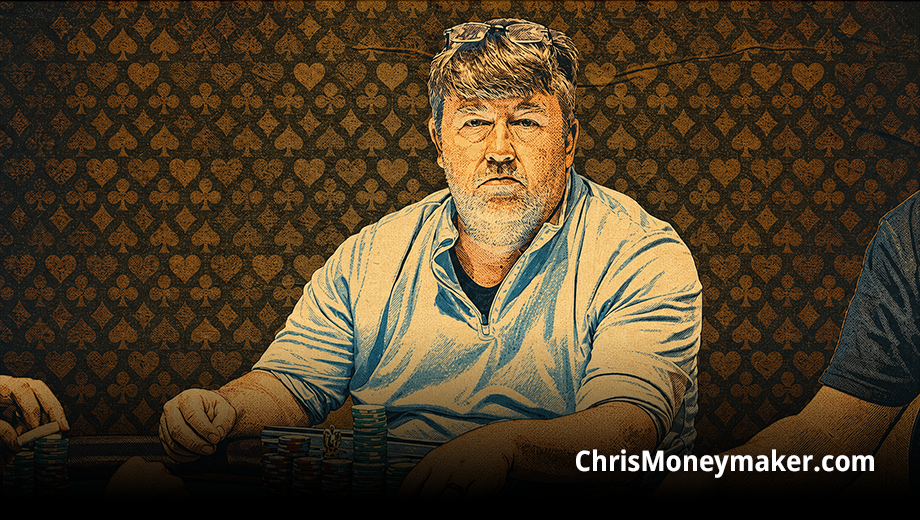

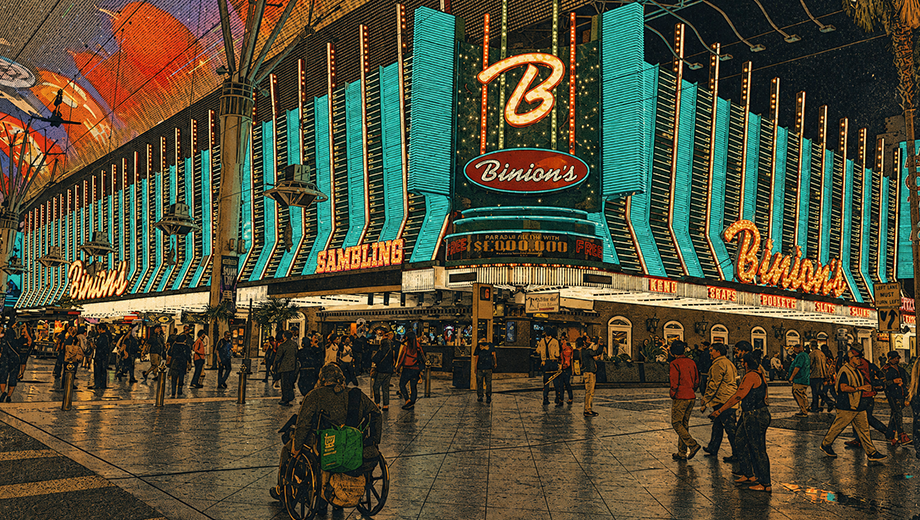
The ceilings at Binion’s felt six feet tall. They’d pulled the slot machines out and replaced them with poker tables. Players were tracked on a whiteboard with a magic marker. Upstairs, in Benny’s Bullpen, there were roughly 40 tables crammed into one room. Some years before, smoking was allowed — the air so thick you had to duck below it just to breathe. That’s where the World Series of Poker lived.
I walked in for the first time in 2003 not knowing what I was looking at. I’d never been to the WSOP. Never played at this level. I had $200 in my online account and had accidentally entered the satellite that got me there. Nothing about that room matched what I’d imagined — mostly because I hadn’t imagined it at all.
What I found was something between a sports arena and a church basement. Intense and unglamorous at the same time. That combination is still what the Main Event feels like, even today.
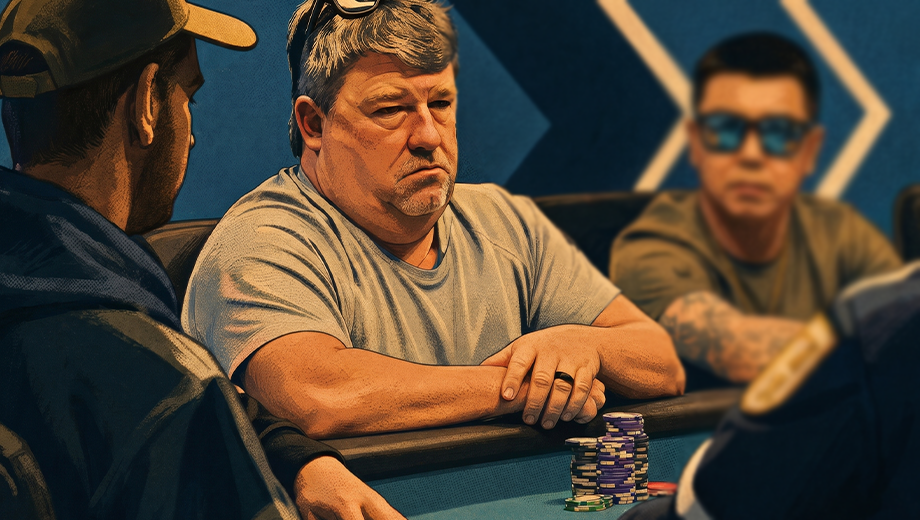
What the Room Actually Looks Like
People expect something cinematic. Lights, drama, a sense of occasion. And there’s some of that — but it comes later, and it’s quieter than you’d think.
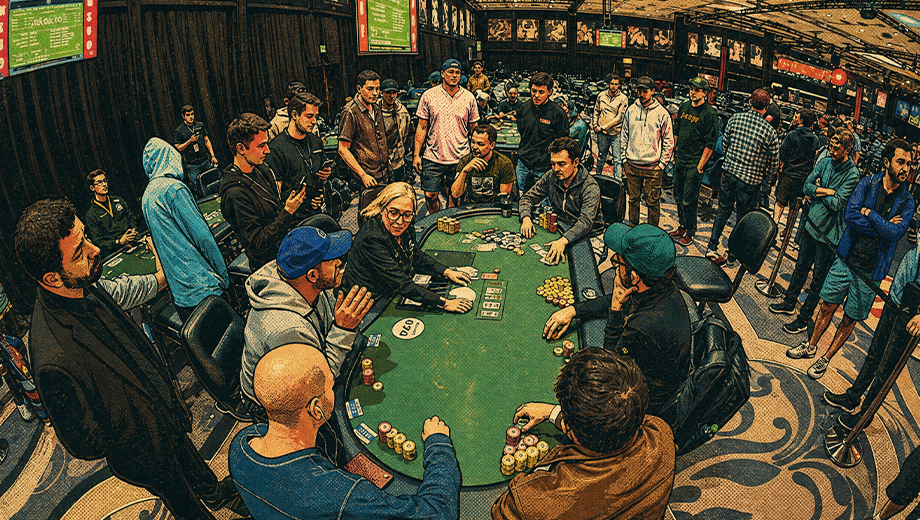
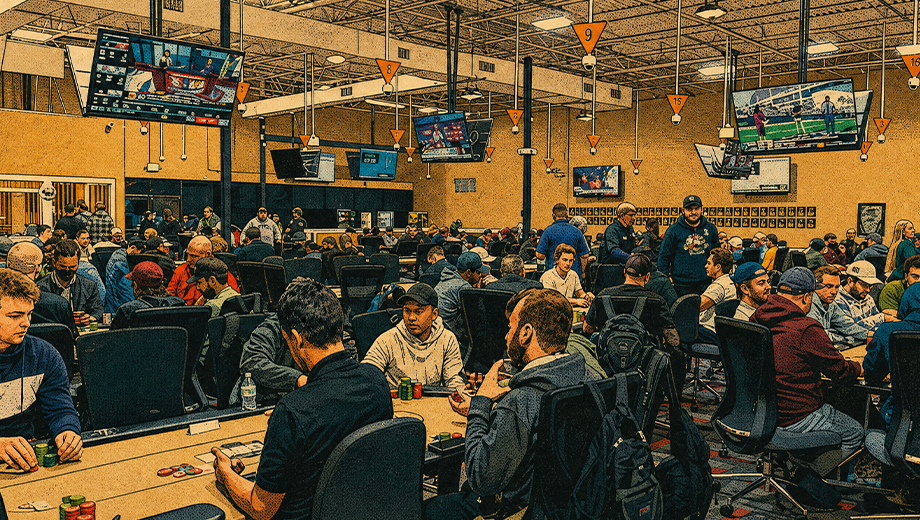
Day 1 is mostly bureaucratic. Thousands of players finding their seats, stacking chips, figuring out where the bathrooms are. The noise is low-grade and constant — chip shuffling, card riffling, the occasional dealer announcement. Nobody’s celebrating anything yet. Everyone’s just trying to survive the first eight hours without doing something stupid.
The room smells like coffee and carpet. There are camera rigs overhead that most players stop noticing by the second level. The ESPN crew moves through the floor looking for action, and you can tell where they are by the cluster of observers that follows. If they stop near your table, someone at it is probably in trouble.
What strikes you, once you settle in, is how ordinary it all is. The players look like people you’d see at a hardware store. Some are wearing headphones. Some are reading. A few are doing what I do — folding everything and watching the table like it’s a documentary worth studying.
The Sound of 8,000 People Playing Poker
By the time the Main Event hit its peak years — 2006, 2007, over 8,000 entries — the room had expanded well beyond Binion’s. The Rio became the home. More space, more tables, better production. But the sound didn’t change much.
It’s a specific kind of noise. Not loud in the way a concert is loud. More like a sustained hum with punctuation. The crack of chips hitting the felt. The murmur of a player talking through a hand. The PA system calling for a clock on someone who’s taken three minutes to decide whether to call a river bet with a pair of fives.
What you don’t hear much of is conversation. Day 1 of any big tournament is quieter than people expect. Players are in their heads. They’re sizing each other up. They haven’t been at the table long enough to know who talks and who doesn’t, who’s running hot, who’s on a short stack and getting desperate. The conversation starts on Day 2. By Day 3, some tables feel like old friends — in the dark way that you’ve watched each other lose money for three days straight.
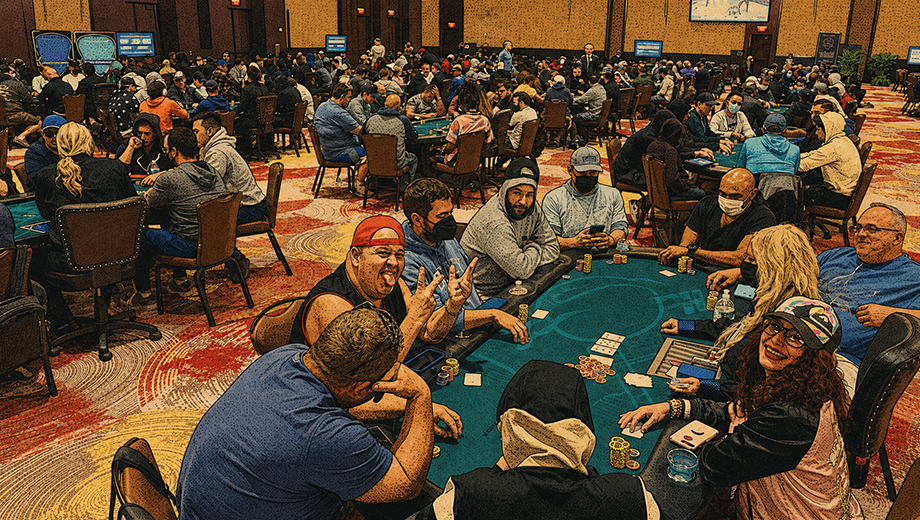
How the Energy Shifts Day by Day
Day 1 is a waiting room. Day 2 is when the tournament actually starts.
The field drops fast after Day 1. Half the entrants don’t make it. The ones who do come back with a different energy — relieved, more settled, readier to play. Stacks have separated. There are short stacks who know they need to move and big stacks who can afford to wait. The dynamics are readable in a way they weren’t the day before.
That’s when I start paying attention differently. Early in the tournament, I fold a lot and watch. Every hand I’m not in, I’m trying to figure out what everyone’s holding. By showdown, I check whether I was right. It’s not exciting work. But by Day 2, I know more about most players at my table than they’ve shared on purpose.
The bubble is its own atmosphere entirely. Everyone knows where the money line is. Short stacks go into survival mode — they’ll fold hands they should be jamming. Big stacks use that. I learned to use it instinctively before I knew it had a name. The tension in the room on bubble day is different from any other day. Quieter in some ways, more electric in others. People are playing for their tournament lives on every hand, and you can feel it.
What Binion’s Had That the Rio Doesn’t
I’ve played the Main Event at both. They’re different experiences.
Binion’s was cramped, downtown, slightly falling apart in the way that old Las Vegas always was. The wall of champions was right there — framed photos of every Main Event winner going back decades. You could walk up and read the names while you were on a break. It felt like the history was physically in the room with you.
The Rio is bigger, cleaner, more professional. The production is better. There’s more space to move. But it’s a convention center at heart — optimized for volume, not atmosphere. The history lives in the trophy case, not in the walls.
Neither is better or worse. They just feel different. Binion’s felt like something that had survived. The Rio feels like something that was built. Both have held the same tournament. The tournament is what matters.
The Numbers That Show How Much It Changed
The atmosphere shifts when the field size shifts. Here’s what the Main Event looked like across the years that changed everything.
| Year | Entries | First Place Prize | Venue |
|---|---|---|---|
| 2002 | 631 | $2,000,000 | Binion’s Horseshoe |
| 2003 | 839 | $2,500,000 | Binion’s Horseshoe |
| 2004 | 2,576 | $5,000,000 | Binion’s Horseshoe |
| 2005 | 5,619 | $7,500,000 | Rio All-Suite Hotel |
| 2006 | 8,773 | $12,000,000 | Rio All-Suite Hotel |
| 2023 | 10,043 | $12,100,000 | Horseshoe Las Vegas |
839 players in a cramped room above a casino. Then 8,773 in a convention center two years later. The atmosphere didn’t just grow — it transformed into something else entirely.
What Stays the Same Every Year
I’ve played the Main Event every year since 2003. The venues change. The field sizes fluctuate. The faces are different. But a few things don’t move.
The first level is always the same. Careful. Quiet. Everyone sizing everyone else up and giving very little away. The bubble day is always the same — that specific tension that lives in a room full of people trying not to lose something they’ve spent days building. And the final table is always the same: nine people who didn’t expect to still be there, playing for something that will follow them the rest of their lives whether they win or not.
The atmosphere inside the WSOP Main Event isn’t what the TV coverage suggests. It’s less dramatic in the moment and more so in retrospect. You’re too busy playing to feel the weight of it. That comes later — usually on the flight home, when you have nowhere to be and nothing to do but think about the hands you played and the ones you didn’t.
The Moneymaker Tour was built on the same basic idea — give players a real tournament experience without the $10,000 buy-in. The feeling in the room is what people come back for. That part doesn’t require a buy-in of any particular size.
Frequently Asked Questions
What is the atmosphere like inside the WSOP Main Event?
Less cinematic than TV suggests. Day 1 is quiet and deliberate — thousands of players conserving energy and studying their tables. The intensity builds day by day as the field shrinks. The bubble day carries its own specific tension. The final table is where it becomes something else entirely.
Where was the WSOP Main Event held in 2003?
The 2003 WSOP Main Event was held at Binion’s Horseshoe in downtown Las Vegas. Players were tracked on a whiteboard with a magic marker. The main playing area, Benny’s Bullpen, held around 40 tables. The event moved to the Rio All-Suite Hotel beginning in 2005.
How did the WSOP Main Event field size change after 2003?
In 2003 there were 839 players. By 2004 that jumped to 2,576 — the first post-Moneymaker year. By 2006 it reached 8,773, more than ten times the 2003 field. The growth was driven by the ESPN broadcast of the 2003 win and the explosion of online poker that followed.
What is the bubble like at the WSOP Main Event?
The bubble day carries a distinct tension. Short stacks go into survival mode — folding hands they should be playing, just trying not to bust before the money. Big stacks use that dynamic aggressively. The room gets quieter and more electric at the same time. Every hand feels like it matters more than it normally would.
How does Moneymaker approach Day 1 of the WSOP Main Event?
He folds a lot and watches. Every hand he’s not involved in, he tries to figure out what everyone is holding and checks himself at showdown. By the end of Day 1 he has a detailed read on most players at his table — not from conversation, but from observation. Day 2 is when he starts to play more actively.
Has Chris Moneymaker played the WSOP Main Event every year since 2003?
Yes. He has played the WSOP Main Event every year since winning it in 2003. It’s the one tournament where the full story of what happened that year is right in front of you — the monitors, the cameras, the people who remember watching the ESPN broadcast. He describes it as the one event where the history is impossible to ignore.