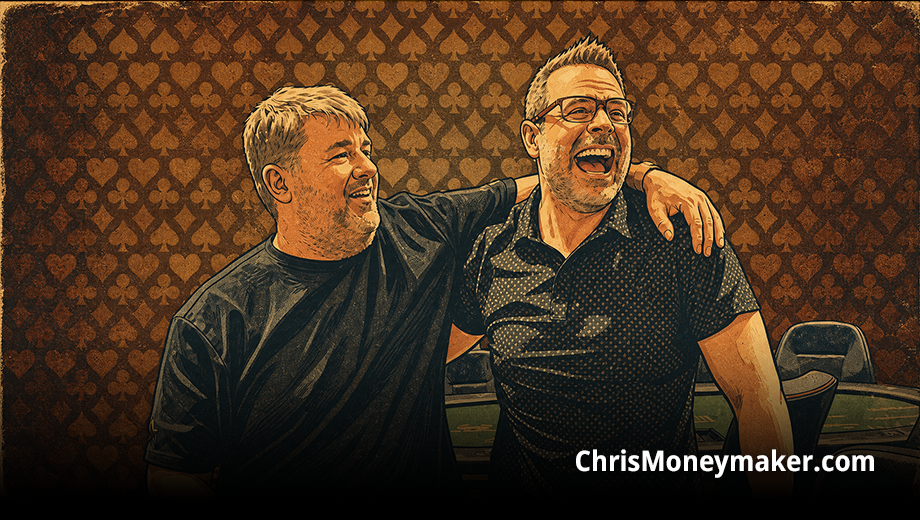

Sometimes poker gives you exactly what you need.
This week at the WSOP, those turned out to be two very different things.
I came into Day 2 of the Monster Stack feeling optimistic. The previous day had ended in disappointment, but not the kind that keeps you up at night. I had a fresh 50,000-chip starting stack, a clear head, and a simple goal: build a stack and make a run.
The backup plan, however, was a lot more interesting.
If things went sideways, there was a $100/$200 cash game waiting for me at Paris.
And I have to admit, I was already looking forward to it.
One Last Shot at the Monster Stack
The day actually started well.
Without ever showing down a hand, I managed to build my stack from 50,000 to around 80,000 chips. That’s one of the underrated parts of tournament poker that people don’t always appreciate.
You don’t need aces.
You don’t need huge coolers.
Sometimes you just need to recognize opportunities and apply pressure.
For a while, everything was moving in the right direction.
Then poker happened.
A player decided to put a big chunk of chips into the middle with a hand that I was more than happy to play against.
Unfortunately, he connected with the board in exactly the way he needed to.
Just like that, my final bullet in the Monster Stack was gone.
The strange thing?
I wasn’t upset.
Not even close.
As soon as I stood up from the table, my first thought wasn’t about the bustout.
It was about the cash game.
Watch the vlog here:
And honestly, that’s where the day got interesting.
Research Mode
Most people assume that cash games are easier than tournaments.
They aren’t.
They’re different.
The lineup I was heading into featured several players I’d never played with before, so I spent the next couple of hours doing something I don’t think enough poker players do:
Homework.
I watched footage.
I researched playing styles.
I tried to figure out who was aggressive, who was cautious, who liked to gamble, and who liked to put people in tough spots.
One player collected Porsches.
Another wore a watch that probably cost more than my first house.
I wasn’t planning on bluffing that guy anytime soon.
Back Where I Belong
There’s something about sitting down in a big cash game that immediately sharpens your focus.
Tournament poker can become a grind.
You play all day waiting for spots.
Cash games force you to stay engaged every second.
The lineup included some familiar names, some personalities from the streaming world, and enough action to make things interesting.
Almost immediately, I remembered why I enjoy cash games so much.
Every decision matters.
Every mistake costs real money.
And unlike a tournament, one bad hand doesn’t end your day.
Queens, Kings, and Survival
One of the biggest pots of the night could have gone very differently.
At one point, I found myself holding pocket queens against pocket kings.
Normally, that’s the kind of hand that can send you straight to the cage.
Somehow, I managed to avoid maximum damage and survive.
Looking back, it was one of the most important moments of the session.
Not because I won.
Because I didn’t lose everything.
There’s a difference.
In cash games, survival can be just as valuable as aggression.
The Rampage Problem
Then there was Rampage.
If you’ve ever had one of those sessions where one player seems to have your number no matter what you do, you’ll understand exactly what I’m talking about.
Every time I looked down at a decent hand, he had a better one.
Every time I convinced myself he couldn’t possibly have it, he had it.
At one point, I honestly felt like I was just donating directly to his bankroll.
He played great.
I guessed wrong.
And he punished me for it all night.
I probably lost more than $100,000 to him during the session.
Which is not exactly the statistic I was hoping to share in this blog.
The Weirdest Win
Here’s the funny part.
Despite all of that, I still walked away a winner.
When the session ended, I was up about $17,000.
That’s not the headline number people dream about.
Nobody’s writing movies about a $17,000 win.
But honestly, it might have been one of the most satisfying results I’ve had all summer.
The cards weren’t cooperating.
I was getting outdrawn.
I was losing big pots.
I wasn’t running particularly well.
And I still found a way to finish ahead.
Those are the sessions that tell you whether you’re playing well.
Anyone can win when everything goes right.
The real test is what happens when everything goes wrong.
Getting My Head Right
More than anything, the cash game reminded me of something I needed to hear.
I wasn’t fully locked in during some of these smaller buy-in tournaments.
Not intentionally.
But it’s human nature.
When you’ve played as many tournaments as I have, sometimes you start going through the motions.
The cash game snapped me out of that immediately.
When you’re sitting in a game where every decision can swing tens of thousands of dollars, your focus sharpens very quickly.
By the end of the night, I felt better about my game than I had in days.
The Monster Stack was over.
The cash game was finished.
But my confidence was back.
And that’s worth a lot more than one tournament cash.
Tomorrow it’s back to the WSOP grind.
More bullets.
More chips.
More opportunities.
But for one night, I was reminded why I fell in love with poker in the first place.
Sometimes the universe knows exactly where you’re supposed to be.