

The ceilings at Binion’s felt six feet tall. They’d pulled out the slot machines and replaced them with poker tables. Players were tracked on a whiteboard with a magic marker. There was no big production, no dramatic entrance tunnel, no LED screen showing the chip counts. Just a cramped room above a casino in downtown Las Vegas that smelled like the previous decade.
I walked in as the guy who’d never played at this level. I didn’t know what I was walking into — not really. I’d qualified online, I had a seat, and I was showing up. That was the plan. Everything else I figured I’d sort out as I went.

What Binion’s Actually Looked Like in 2003
People have this image of the World Series of Poker as this enormous, polished event. In 2003, it wasn’t. The tournament was held upstairs in what they called Benny’s Bullpen — roughly forty tables packed into one room. No marble floors. No camera cranes. The kind of space that made you feel like you’d wandered into a private game that got out of hand.
The smoke from previous years had finally been banned, but you could still sense it in the walls. And the organization — if you could call it that — was basic. Your name was on a whiteboard. A guy with a marker told you your table and seat. That was check-in.
839 players had entered. Less than eight percent of them would cash. I didn’t know those numbers walking in. I just knew it was a lot of people, most of them had been doing this a long time, and I had not.
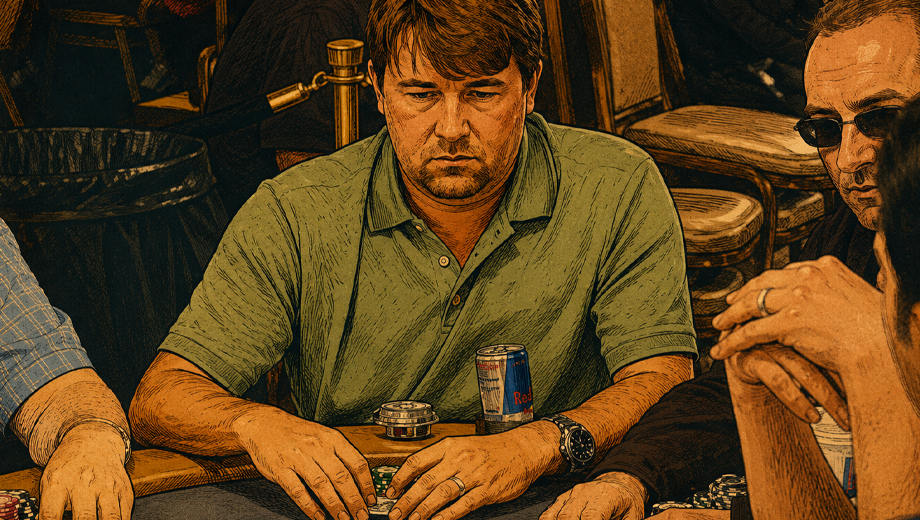
I Only Knew Three Names in the Entire Field
Before I got to Las Vegas, I could name exactly three professional poker players: Phil Hellmuth, because of his bracelet count; Doyle Brunson and Johnny Chan, because of Rounders. That was the full list.
I sat down on Day 1 and the man two seats to my right turned out to be Dan Harrington. I had to check the wall of champions to figure out who he was. He looked like someone’s accountant — which I suppose is also how I looked, because I was one.
The thing is, that ignorance turned out to be a strange kind of asset. I wasn’t intimidated by names I didn’t know. The players who scared me were the old veterans — the ones who’d been playing live poker for twenty years and had that look that said they’d seen every bluff you were about to run. The young players, the online players, anyone around my age — they didn’t register as threats at all.
When I eventually ran into Phil Ivey, I saw a young guy with a big stack of chips. That was the read. Nothing more. I found out later he was considered the best player in the world at the time. I had zero idea, which is probably the only reason I called his shove at 4am and won the hand.

The Real Feeling — And What Nobody Mentions
Everyone wants to know what it feels like walking into something that big as an unknown. The honest answer is: less dramatic than you’d think, and more lonely than you’d expect.
There was no one there for me. No rail. No group of friends in matching t-shirts screaming when I won a pot. I’d told my bosses at the restaurant group I worked for that I’d be back Monday morning if things didn’t work out. I’d taken a week off. Nobody at home quite understood what I was playing in.
So you sit down, you play cards, and you try to stay focused. Day 1 of a big tournament is honestly boring for the first several hours. You’re playing short-handed pots, feeling people out, not committing anything. The real tournament doesn’t start until Day 2, when the field thins out enough that every decision starts to carry real weight.
My approach was simple: when I folded a hand, I watched the rest of it and tried to guess what everyone was holding. When the cards got shown down, I checked. I was right a lot more than I expected. It’s not a superpower. It’s just paying attention when most people are looking at their phones — except in 2003, people were looking at nothing. There were no phones to look at.

The Stack That Surprised Everyone — Including Me
I started with 10,000 chips. By the end of Day 1, I had bagged 60,000. Six times my starting stack. I don’t know exactly how it happened — I won the pots I was supposed to win, I made a few moves that worked, and I ran well. That combination, on one day, can do a lot.
What mattered more than the chips was the pattern: every two-hour level, I found a way to grow my stack. With one exception on Day 2 — a bad run-out on a big pot that left me staring at the parking lot outside trying to regroup — the stack kept going in the right direction.
The very next hand after that low point, I was dealt pocket aces and nearly doubled up immediately. That’s poker. The mental fragility right there, in that moment, is the part the televised highlights never show. I was genuinely shaken. If I’d run bad for another orbit, I don’t know who I am in that tournament. The aces came at the exact right time.
What the 2003 Field Looked Like Compared to Today
The numbers tell the story better than any description. Here’s what the WSOP Main Event field looked like in the years around the 2003 win.
| Year | Entries | First Place Prize |
|---|---|---|
| 2001 | 613 | $1,500,000 |
| 2002 | 631 | $2,000,000 |
| 2003 | 839 | $2,500,000 |
| 2004 | 2,576 | $5,000,000 |
| 2005 | 5,619 | $7,500,000 |
| 2006 | 8,773 | $12,000,000 |
From 839 players to 8,773 in three years. Something changed. It wasn’t just me — it was the idea that someone like me could show up and win.

The Part That Stays With You
I won on a Friday, flew home Saturday, and was back at work Monday morning. The ESPN broadcast didn’t air until August — three or four months after it happened. So I returned to a world where maybe thirty people knew what had occurred. The internet was reporting it, but this was 2003. There was no social media. There were flip phones and phone calls.
My first reaction watching myself on television was to turn to a friend and say: “Am I that fat?” He said yes.
I kept working for eight more months. Eventually my boss told me that if I didn’t quit, he was going to fire me, because I was wasting my time. He was right. It took me a couple more months to find a replacement and train them properly. Then I left.
The whole experience — walking in unknown, winning, going back to work, watching it on TV months later — felt less like a transformation and more like a series of ordinary days that added up to something extraordinary. Which is maybe the truest thing I can say about what it actually feels like.
If you’re thinking about playing the Main Event and you’ve never done it before, the ACR satellite schedule is where the path still starts — same format, different era.
Frequently Asked Questions
How did Chris Moneymaker qualify for the 2003 WSOP Main Event?
Moneymaker qualified through an $86 satellite on PokerStars — which he entered by accident, thinking it was a cash sit-and-go. He won that satellite into a $615 qualifier with 69 players, which awarded three Main Event seats. He won one of those seats and went to Las Vegas.
How many players were in the 2003 WSOP Main Event?
839 players entered the 2003 WSOP Main Event at Binion’s Horseshoe in Las Vegas. The total prize pool was $7,987,860, and 63 players cashed — less than eight percent of the field. Moneymaker won the $2,500,000 first-place prize.
What was Chris Moneymaker’s chip count after Day 1 of the 2003 WSOP?
Moneymaker bagged 60,000 chips at the end of Day 1, starting from the 10,000 chip starting stack — six times the starting count. He grew his stack in nearly every two-hour level throughout the tournament.
Did Chris Moneymaker know any of the professional players at the 2003 WSOP?
He knew exactly three names going in: Phil Hellmuth, Doyle Brunson, and Johnny Chan. He didn’t recognize Dan Harrington when he sat two seats to his right on Day 1 and had to check the wall of champions. He had no idea who Phil Ivey was when they played their famous hand at 4am.
What did Chris Moneymaker do after winning the 2003 WSOP Main Event?
He flew home the day after winning and went back to work at his accounting job the following Monday morning. The ESPN broadcast didn’t air until August — roughly three months later — so he returned to a world where almost no one knew what had happened. He continued working for eight more months before finally leaving.
How did the 2003 WSOP win change the size of the Main Event?
The field grew dramatically. In 2003 there were 839 players. By 2004 — the first year after the ESPN broadcast aired — entries jumped to 2,576. By 2006, the field reached 8,773 players. The idea that an online amateur with an $86 buy-in could win opened the tournament to an entirely new kind of player.